Spring Boot vs Quarkus: Performance Is Solved. Architecture Isn’t.
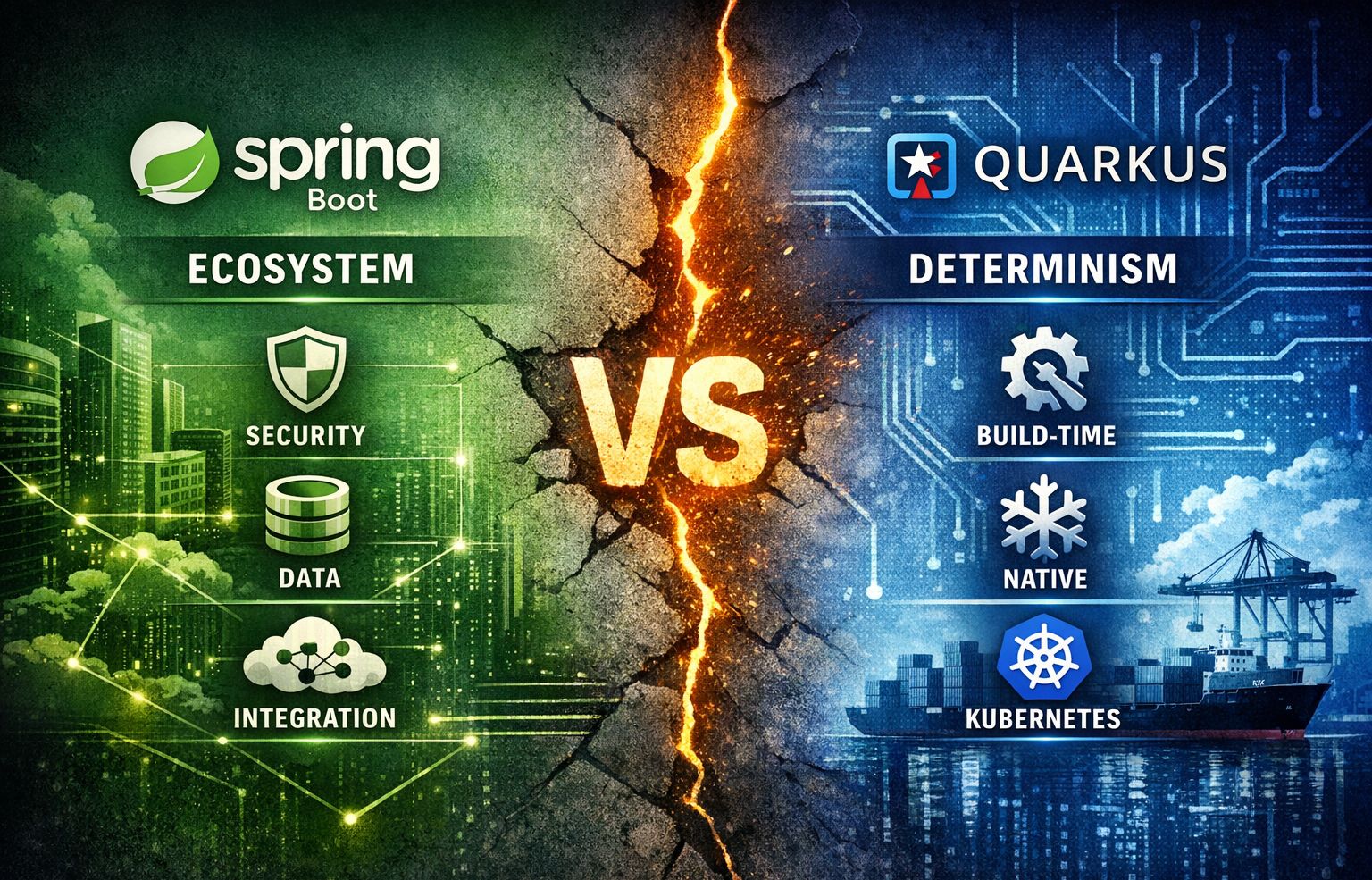
We’re still comparing frameworks using metrics that stopped mattering years ago.
Startup time and memory are no longer the real differentiators.
In 2026, with Java 25 + GraalVM Native, both Spring Boot and Quarkus perform extremely well.
The real difference is architectural.
Quarkus was built for build-time:
- DI resolved at build time
- Minimal reflection
- Native-first design
- Deterministic behavior
Spring Boot evolved into it:
- AOT engine (Spring Boot 3/4)
- Reduced reflection
- Native hints instead of runtime discovery
- Modularized for native builds
Both now align with GraalVM.
But Quarkus is native by design.
Spring is adapted.
That difference shows up here:
Predictability vs Flexibility
Quarkus:
- More predictable
- Fewer native surprises
Spring:
- More dynamic
- Easier integration
- More mature ecosystem
And in real systems, this matters more:
You are not optimizing startup time.
You are dealing with:
- Kafka pipelines
- TLS / mTLS
- Cryptography (FIDO2, PQC)
- Legacy banking systems
Your bottlenecks are:
- Network I/O
- Serialization
- External dependencies
Not your framework.
Also, with Java 25:
Virtual Threads changed everything.
- Spring MVC scales like reactive
- Quarkus supports imperative + reactive
The “reactive vs imperative” debate is basically over.
So the real question is:
Which framework reduces total system complexity?
For me:
Spring Boot 4 + GraalVM Native:
- Strong ecosystem
- Faster delivery
- Less reinvention
Quarkus is elegant.
But in large, regulated systems, ecosystem beats elegance.