From 2 Days to 5 Minutes: Ruthless Infrastructure Automation
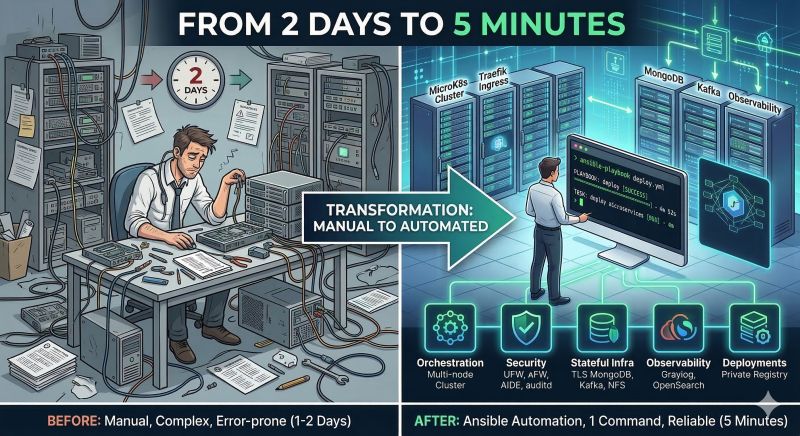
Not long ago, setting up a full staging or production environment used to take 1–2 days. It was a process defined by manual installation, configuration steps scattered across outdated documents, and the inevitable environment inconsistencies that follow. Eventually, something would always break.
I decided to remove this manual friction entirely. By converting the entire infrastructure setup into a fully automated Ansible pipeline, what used to take days now deploys a production-ready environment in about 5 minutes with a single command.
Beyond Spinning Up VMs
This automation isn't just about provisioning virtual machines; it's about bootstrapping a full platform stack with architectural depth:
Orchestration & Networking
Deploys a multi-node MicroK8s cluster with MetalLB and Traefik Ingress, ready for high-traffic workloads.
Security by Default
Applies an Ubuntu security baseline out-of-the-box, including UFW firewall, auditd, and AIDE for file integrity monitoring.
Stateful Infrastructure
Automates NFS storage provisioning, TLS-enabled MongoDB replica sets, and Kafka brokers for robust data persistence.
Observability & Deployment
Bootstraps Graylog + OpenSearch for centralized logging and handles zero-touch microservices deployment with private registry authentication.
The Architectural Impact
This shift to infrastructure-as-code has fundamentally changed how we operate. The gains in velocity are immediate, but the long-term architectural benefits are even more significant:
- Consistency: Identical layouts across all environments (test → staging → production).
- Reliability: Elimination of configuration drift and "snowflakes."
- Traceability: Infrastructure is version-controlled alongside application code, providing a clear audit trail.
- Velocity: New environments can be spun up in minutes, allowing for rapid experimentation and testing.
Sometimes the biggest productivity gains don’t come from adopting the newest technology. They come from ruthlessly removing manual friction from the system. In regulated environments where failure is not an option, automation isn't just a convenience—it's a requirement for security and stability.